
Playbook and Tagbox.io are both modern, AI-powered DAM platforms designed to help teams organize and search visual media.
While Tagbox.io focuses primarily on asset organization and retrieval, Playbook is built to support the entire creative workflow from decluttering your asset library to campaign-ready output.
For marketing and creative teams, the difference isn’t just how fast you can find assets — it’s how easily you can turn them into actual work.
Playbook vs. Tagbox.io
More than an asset library — a home base for complete creative workflows
| Playbook | Tagbox.io | |
|---|---|---|
| Pricing and accessibility | ||
| Pricing transparency | Flexible team member-based pricing. Accessible even for smaller teams | Flat monthly subscriptions. |
| Storage | Teams start with 5TB | Teams start with 100GB |
| Onboarding | ||
| Getting started | Self-serve. Start immediately. No sales calls required. | Self-serve onboarding. |
| Migration & Implementation | Instant import from Google Drive, Dropbox, and more. Start same day. | Upload-based setup with AI-powered organization. |
| Feature set | ||
| Core product | Digital Asset Management (DAM) + creative workflow platform | AI-first DAM focused on media search and organization |
| AI capabilities | AI-powered image and video search, smart tagging, OCR, scene detection, and built-in AI chat | Deep image search, facial recognition, auto-tagging |
| Search experience | AI-powered conversational search plus the ability to take action on results | Strong AI search across faces, logos, objects, and scenes |
| Search → action workflow | Find, organize, tag, group, share, and publish in one place | Strong retrieval, but less built around taking the next workflow step |
| Asset management | Built for videos, images, Adobe files, PDFs, docs, and full campaign libraries | Focused primarily on organizing and retrieving visual media |
| Video workflows | Strong support for previewing, collaborating on, and managing videos alongside other assets | Supports some video search with less emphasis on broader collaboration |
| Tagging and metadata | Flexible tags + custom fields + editable AI tags | Strong AI tagging, but less flexible for team-defined workflow structure |
| Collaboration & review | Comments, approvals, workflows, and collaboration built into one workspace | Supports simple collaboration with less review and approval workflows |
| Sharing and presentation | Share links, branded pages, templates, and presentation-ready publishing | Guest links and basic showcases |
| Supports AI-powered search | Yes — plus built-in AI chat to help organize and take action on assets | Yes — with strong facial recognition and deep visual search |
| Creative workflow support | End-to-end workflows: organize, review, share, publish, and present | Primarily focused on searchability and retrieval |
Why Teams Choose Playbook
Playbook is designed for how creative teams naturally think:
- Visual, drag-and-drop interface
- Boards that mirror campaigns, shoots, and launches
- No rigid setup or learning curve
Teams can get started immediately — and it's clear the product was built by creatives, for creatives.
AI in Playbook goes beyond tagging and retrieval. With Playbook Intelligence, you can:
- Tell your files what to do, from adding tags to removing backgrounds — just prompt it in chat built straight into your workspace
- Use AI to organize and get tailored suggestions on how to best structure your content
- Quickly find assets and immediately take action — for example, "find all images with silver bracelets and create a shareable board"
AI becomes a thought partner and execution layer, not just a search tool.
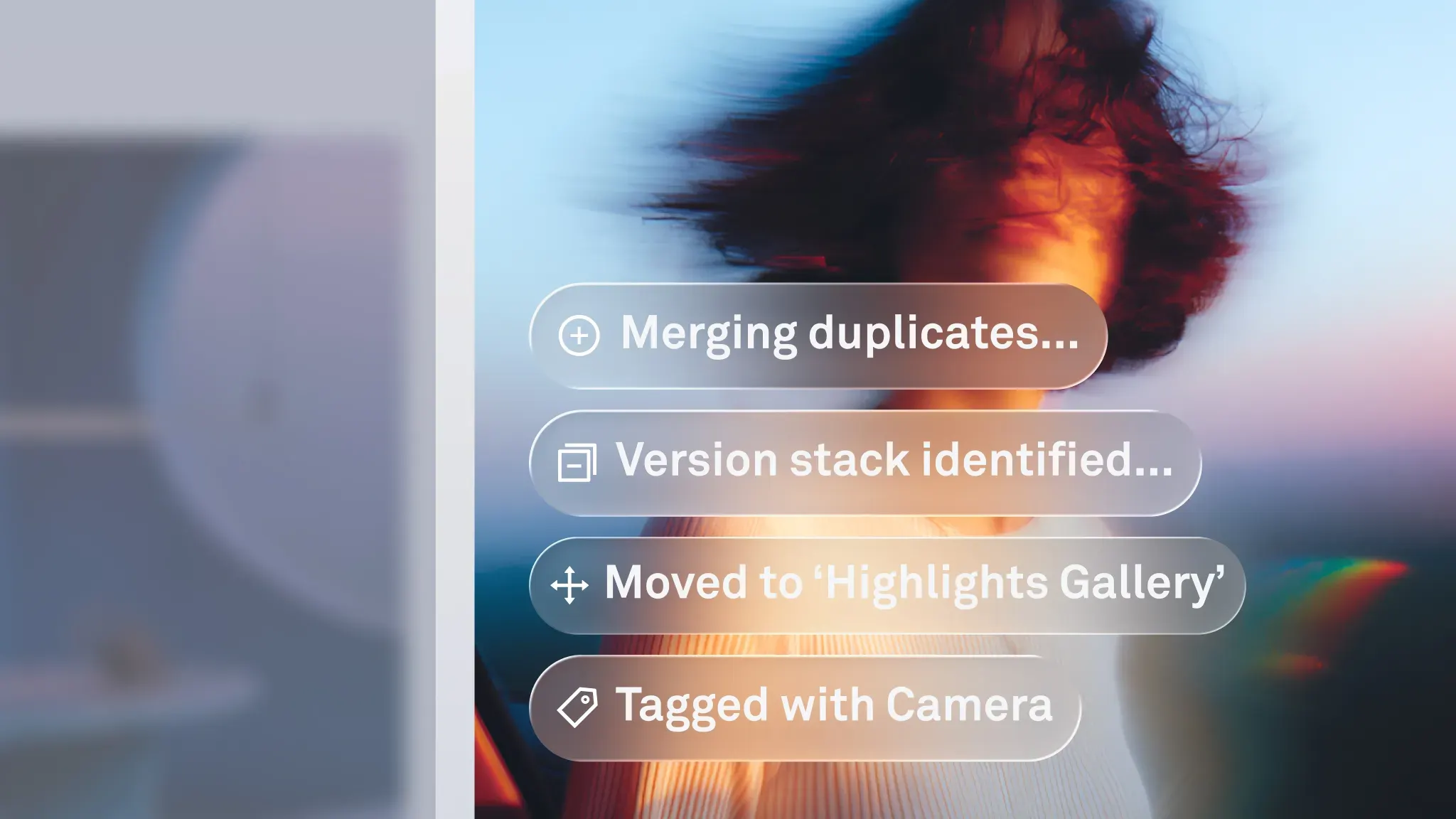
Creative work isn't static — it requires iteration. Playbook supports:
- Version history and side-by-side asset comparisons
- Timestamp and exact-position commenting directly on assets
- Clear progression from draft → review → final
In Playbook, you get everything needed to move work forward — not just a place to store it.
Instead of relying only on AI guesses, Playbook lets you set board rules to require specific fields or auto-apply them on upload. This allows teams to:
- Automatically enrich file metadata for findability
- Maintain consistency across teams
- Lock boards and define asset-level access
You create the structure once and it scales with you.
Playbook is built to support end-to-end video workflows, not just finding images:
- Preview and scrub video assets
- Collaborate and review alongside images and design files
- Organize footage across shoots, edits, and final deliverables
Designed for teams producing real content at scale, not just indexing media.
Many teams still layer additional tools for organizing final selections, managing feedback, and sharing polished outputs. Playbook brings all of this together — share via client galleries and branded pages, or publish directly from your library using ready-made templates.
For teams that need to integrate Playbook into their broader stack, the SDK and API are available on Business plans.
Frequently asked questions
What is the best Tagbox alternative for digital asset management?
Playbook is a strong Tagbox alternative for teams needing AI-powered digital asset management. It combines automated AI tagging, smart search, visual asset organization, review and approval workflows, and client delivery portals — built for creative teams, agencies, and brand teams managing photos, videos, and design files.
How does Playbook compare to Tagbox?
Both Tagbox and Playbook use AI to automatically tag and organize visual assets. Playbook goes further with conversational smart search, AI-powered organization and batch actions, branded client delivery galleries, a Publish feature for external portals, and a Business plan with API and SDK access for custom integrations. Tagbox focuses more heavily on facial recognition and event photo sharing use cases.
Does Playbook have AI tagging like Tagbox?
Yes. Playbook automatically tags every uploaded asset by content, mood, color, subject, and product with no manual input required. Smart search then lets users find any asset using natural language queries. AI tagging is included on the Team plan at $25/month per member.
Is Playbook free to try?
Yes. Playbook has a free plan with 100GB storage and up to 300 assets. Paid plans start at $12/month. See full pricing at playbook.com/pricing.